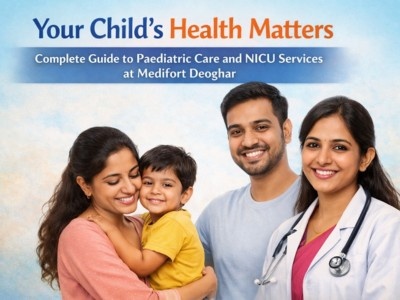
Your Child's Health Matters — Complete Guide to Paediatric Care and NICU Services at Medifort Deoghar
- Home
- Blog
Every parent wants the best possible care for their child — from the very first breath after birth through every milestone of childhood. Yet in many parts of Jharkhand, families still travel long distances to access reliable paediatric expertise, often losing precious time during medical emergencies. Having a trusted paediatrician in Deoghar who understands childhood illness, newborn care, and the specific health challenges of this region is not a luxury — it is a necessity that directly shapes a child’s long-term health and development.
This guide is written for parents, expecting families, and caregivers who want to understand what comprehensive child healthcare looks like, when to seek medical attention, and what services are available locally to support their child’s wellbeing from birth onward.
Understanding Paediatric Care: What It Covers and Why It Matters
Paediatrics is the branch of medicine dedicated entirely to the health of infants, children, and adolescents — from birth up to 18 years of age. Children are not simply small adults. Their bodies, immune systems, developmental milestones, and responses to illness and medication differ fundamentally from those of adults, which is why specialised paediatric training and expertise matter so much.
Paediatric care encompasses a wide range of services including newborn assessments, vaccination programmes, growth and developmental monitoring, diagnosis and treatment of acute illnesses such as fever, infections, and respiratory conditions, and management of chronic childhood conditions such as asthma, anaemia, and malnutrition.
In the Deoghar and broader Jharkhand context, paediatric health is a particularly pressing concern. Childhood malnutrition, vaccine-preventable diseases, respiratory infections, diarrhoeal illnesses, and newborn complications remain significant contributors to childhood morbidity in the region. Access to a qualified child specialist doctor in Deoghar, Jharkhand — especially one supported by diagnostic and emergency infrastructure — plays a critical role in changing these outcomes for local families.
Common Health Conditions and Risk Factors in Children
Understanding what makes children vulnerable helps parents stay vigilant and seek care proactively. The following are among the most common health concerns in children, particularly in this region:
- Infections and febrile illnesses — Bacterial and viral infections are the most frequent reason for paediatric consultations. Typhoid, malaria, dengue, and respiratory tract infections are prevalent in Jharkhand and can escalate quickly in young children if not treated promptly.
- Malnutrition and anaemia — Inadequate dietary diversity, poor feeding practices in infancy, and iron or vitamin deficiencies affect a significant proportion of children across Jharkhand. These conditions impair immunity, physical growth, and cognitive development.
- Diarrhoeal disease and dehydration — Gastroenteritis is a leading cause of childhood hospitalisation in India. Dehydration from repeated vomiting and loose stools can become dangerous very quickly in infants and toddlers.
- Respiratory conditions — Pneumonia, bronchiolitis, and childhood asthma are major causes of illness and emergency visits. Air quality, crowded living conditions, and tobacco smoke exposure within the home are contributing factors.
- Prematurity and low birth weight — Babies born before 37 weeks of gestation or with a birth weight below 2.5 kg face higher risks of respiratory, nutritional, and developmental complications requiring specialised newborn care.
- Vaccine-preventable diseases — Measles, whooping cough, diphtheria, and other preventable conditions still occur in communities with incomplete immunisation coverage. Maintaining the vaccination schedule is one of the most impactful steps a parent can take.
- Developmental and growth concerns — Delayed milestones, speech delays, poor weight gain, and behavioural concerns benefit from early paediatric evaluation and, where needed, early intervention.
Symptoms in Children You Should Not Ignore
Children often cannot articulate how they feel, which means parents must be alert to physical signs that something is wrong. Some symptoms that seem minor can escalate rapidly in young children, particularly infants.
In newborns and young infants, seek medical attention immediately for:
- Fever above 38°C (100.4°F) in a baby under three months — this is always an emergency
- Difficulty breathing, rapid breathing, or chest in-drawing (when the chest visibly sucks inward between the ribs with each breath)
- Poor feeding, refusal to breastfeed or take a bottle for more than one feeding
- Unusual limpness, extreme sleepiness, or difficulty waking
- Yellowing of the skin or eyes (jaundice) that is spreading or deepening after the first few days
- Continuous crying that cannot be soothed
In older infants and children, watch for:
- High fever above 39°C that does not respond to fever medication or lasts more than two to three days
- Rashes that appear suddenly, spread rapidly, or are accompanied by fever
- Persistent vomiting or diarrhoea with signs of dehydration — dry mouth, no tears, sunken eyes, reduced urination
- Difficulty breathing or noisy, laboured breathing
- Severe headache with neck stiffness, which may indicate meningitis
- Seizures, loss of consciousness, or unresponsiveness
- A child who seems unusually unwell — very weak, not interacting, not interested in their surroundings
For parents wondering when to consult the best paediatrician in Deoghar for newborn vaccination and child fever treatment — the answer is both for routine, scheduled care and for any of the above symptoms. Paediatric care is not only reactive; it is fundamentally preventive.
Diagnosis and Medical Evaluation in Children
Paediatric diagnosis requires a careful, age-sensitive approach. A child specialist will conduct a thorough assessment that includes:
History Taking — The doctor will ask about the child’s symptoms, their duration and progression, feeding habits, vaccination status, birth history, developmental milestones, and family medical history. In infants, birth history including gestational age, birth weight, and any perinatal complications is particularly important.
Physical Examination — A full head-to-toe examination including assessment of weight, height, head circumference, skin, lymph nodes, throat, ears, lungs, abdomen, and neurological reflexes. In newborns, a detailed neonatal examination is performed.
Laboratory Tests — Based on presentation, investigations may include complete blood count (CBC), blood cultures, CRP (C-reactive protein), malaria antigen testing, blood sugar, liver and kidney function, and stool or urine analysis.
Imaging — Chest X-rays are commonly used for respiratory conditions. Ultrasound may be required for abdominal concerns. In cases of suspected neurological involvement, further imaging may be indicated.
Developmental Screening — At routine paediatric visits, doctors use age-appropriate screening tools to assess motor, cognitive, speech, and social development and identify children who may benefit from early intervention.
Treatment Options in Paediatric Care
Treatment in children must always be carefully calibrated for age, weight, and the specific condition being managed.
Medications — Antibiotics, antivirals, antipyretics, bronchodilators, and other medications are prescribed in weight-based doses appropriate for the child’s age. Self-medicating children with adult formulations or without medical guidance carries real risks.
Oral Rehydration Therapy (ORS) — For mild to moderate dehydration from diarrhoea or vomiting, ORS is the cornerstone of management and is highly effective when used correctly. Severe dehydration requires intravenous fluids under medical supervision.
Nutritional Management — Malnourished children may require therapeutic feeding protocols alongside treatment of any underlying illness. Breastfeeding support and complementary feeding guidance are integral to infant care.
Hospitalisation and Monitoring — Children with severe infections, breathing difficulties, severe dehydration, or neonatal complications require admission for close monitoring and intravenous treatment.
NICU Care for Newborns — Premature babies and newborns with conditions such as respiratory distress syndrome, birth asphyxia, neonatal jaundice requiring phototherapy, low birth weight, or neonatal sepsis require care in a Neonatal Intensive Care Unit equipped with incubators, ventilators, monitoring systems, and a specialised neonatal team.
Vaccination — Following the national immunisation schedule protects children against measles, polio, diphtheria, tetanus, whooping cough, hepatitis B, rotavirus, and other serious illnesses. Staying on schedule is one of the most important things a parent can do.
Preventive Health Tips for Parents
Much of paediatric care is about prevention. Here are the most impactful steps parents can take to protect their child’s health:
- Follow the vaccination schedule — Do not skip or delay vaccines. Timely immunisation protects your child and the wider community.
- Breastfeed exclusively for the first six months — Breast milk provides optimal nutrition and passive immunity during the most vulnerable period of infancy.
- Introduce appropriate complementary foods from six months — Ensure dietary diversity with iron-rich foods, fruits, vegetables, and adequate protein alongside continued breastfeeding.
- Practise good hygiene — Regular handwashing before meals and after using the toilet reduces the risk of diarrhoeal and infectious diseases significantly.
- Attend routine growth and developmental check-ups — Regular paediatric visits allow early identification of growth faltering, nutritional deficiencies, or developmental delays.
- Keep the home environment smoke-free — Tobacco smoke exposure is a major contributor to childhood respiratory illness and ear infections.
- Ensure safe sleep practices for newborns — Always place infants on their back to sleep on a firm, flat surface and avoid co-sleeping in unsafe environments to reduce the risk of sudden infant death.
When Should You Take Your Child to a Paediatrician?
Routine visits are just as important as illness visits. However, certain situations require prompt medical attention:
- Any fever in a baby under three months old
- A child who appears very unwell, drowsy, or unresponsive
- Breathing difficulties, wheezing, or persistent cough
- Signs of dehydration including dry mouth, no urine output for more than eight hours, or sunken eyes
- A rash accompanied by fever
- Seizures for the first time, or seizures that last longer than usual in a child with a known seizure disorder
- Concerns about a child’s weight, height, or developmental progress
Parents asking when a premature baby needs NICU care in a Deoghar, Jharkhand hospital should understand that any baby born before 35 weeks, weighing below 2 kg, experiencing breathing difficulties at birth, or showing signs of infection or low blood sugar in the first hours of life benefits from NICU support. The sooner such a baby is in a properly equipped neonatal unit, the better the outlook.
How Medifort Wellness Super Speciality Hospital in Deoghar Can Help
Medifort Wellness Super Speciality Hospital is committed to providing high-quality paediatric and neonatal care for families across Deoghar, Dumka, Jasidih, Godda, and the surrounding districts of Jharkhand. The hospital’s paediatric department addresses how Medifort Hospital Deoghar’s paediatrics and NICU department supports safe newborn and child healthcare through a combination of specialist expertise, appropriate infrastructure, and compassionate family-centred care.
The paediatric team includes experienced child specialist doctors who manage the full range of childhood conditions — from routine consultations, vaccination, and growth monitoring to the management of serious infections, respiratory illnesses, and complex neonatal presentations.
The hospital’s NICU is designed to support premature and sick newborns with the monitoring, warming, respiratory, and nutritional support required during the most critical period of a new life. Neonatal care at Medifort is delivered by a team trained in neonatal resuscitation and management, ensuring that vulnerable newborns receive attentive, skilled care from their very first hours.
For parents, the experience of having a sick child — or a premature newborn in the NICU — is one of the most stressful situations imaginable. The team at Medifort prioritises clear, honest, and empathetic communication with families throughout the process, keeping parents informed and involved in their child’s care at every stage.
Frequently Asked Questions
Q1. Who is the best paediatrician in Deoghar for newborn vaccination and child fever treatment? The right paediatrician for your child is one who offers comprehensive care — including scheduled immunisations, growth monitoring, and prompt evaluation of acute illnesses. Medifort Wellness Super Speciality Hospital’s paediatric team provides all of these services for newborns and children across Deoghar and nearby areas.
Q2. When does a premature baby need NICU care in a Deoghar hospital? Premature babies — especially those born before 35 weeks or weighing less than 2 kg — often require NICU care to support breathing, maintain body temperature, receive intravenous nutrition, and manage complications such as neonatal jaundice or infection. The decision is made by the neonatologist based on the baby’s condition at birth.
Q3. What vaccinations does my newborn need and when? India’s national immunisation schedule begins at birth with vaccines for hepatitis B and BCG (tuberculosis). Subsequent vaccines for polio, diphtheria, tetanus, whooping cough, Hib, rotavirus, measles, and others are given at specific intervals in the first two years. Your paediatrician will maintain a vaccination record and guide you through the schedule.
Q4. What are the signs that my child’s fever needs emergency care? Seek emergency care if your child is under three months old with any fever, if the fever exceeds 40°C, if the child has a seizure, if there is difficulty breathing, extreme drowsiness, a rash accompanying the fever, or if the child appears very unwell and is not responding normally.
Q5. Is jaundice in newborns dangerous? Mild jaundice in the first few days of life is common and often resolves without treatment. However, jaundice that appears within the first 24 hours, deepens rapidly, or persists beyond two weeks requires medical evaluation and possibly phototherapy (light treatment). Untreated severe jaundice can cause brain damage, which is why timely assessment by a paediatrician is essential.
Q6. Does Medifort Wellness Hospital in Deoghar have a NICU for premature babies? Yes. Medifort Wellness Super Speciality Hospital has a Neonatal Intensive Care Unit equipped to manage premature and sick newborns, supported by trained medical and nursing staff experienced in neonatal care.
Conclusion
A child’s health in the early years lays the foundation for their entire future — their growth, immunity, cognitive development, and resilience all depend on the quality of care they receive from birth onward. For families in Deoghar and across Jharkhand, having access to qualified paediatric and neonatal care close to home is no longer something to compromise on.
Whether your concern is a routine vaccination visit, a persistent fever, a developmental question, or a premature birth requiring neonatal support — timely, expert paediatric care makes a measurable difference.
If you have questions about your child’s health, vaccination schedule, growth, or if your newborn requires specialist attention, reach out to the paediatrics and NICU team at Medifort Wellness Super Speciality Hospital, Deoghar. Your child’s health is their most valuable asset — and protecting it begins with the right care, at the right time.
This article is intended for general health awareness and educational purposes only. It does not substitute professional medical advice, diagnosis, or treatment. Always consult a qualified healthcare professional for personal medical concerns.