
Kidney Stone Symptoms, Prevention and Laser Treatment — Complete Guide by Urologist at Medifort Deoghar
- Home
- Blog
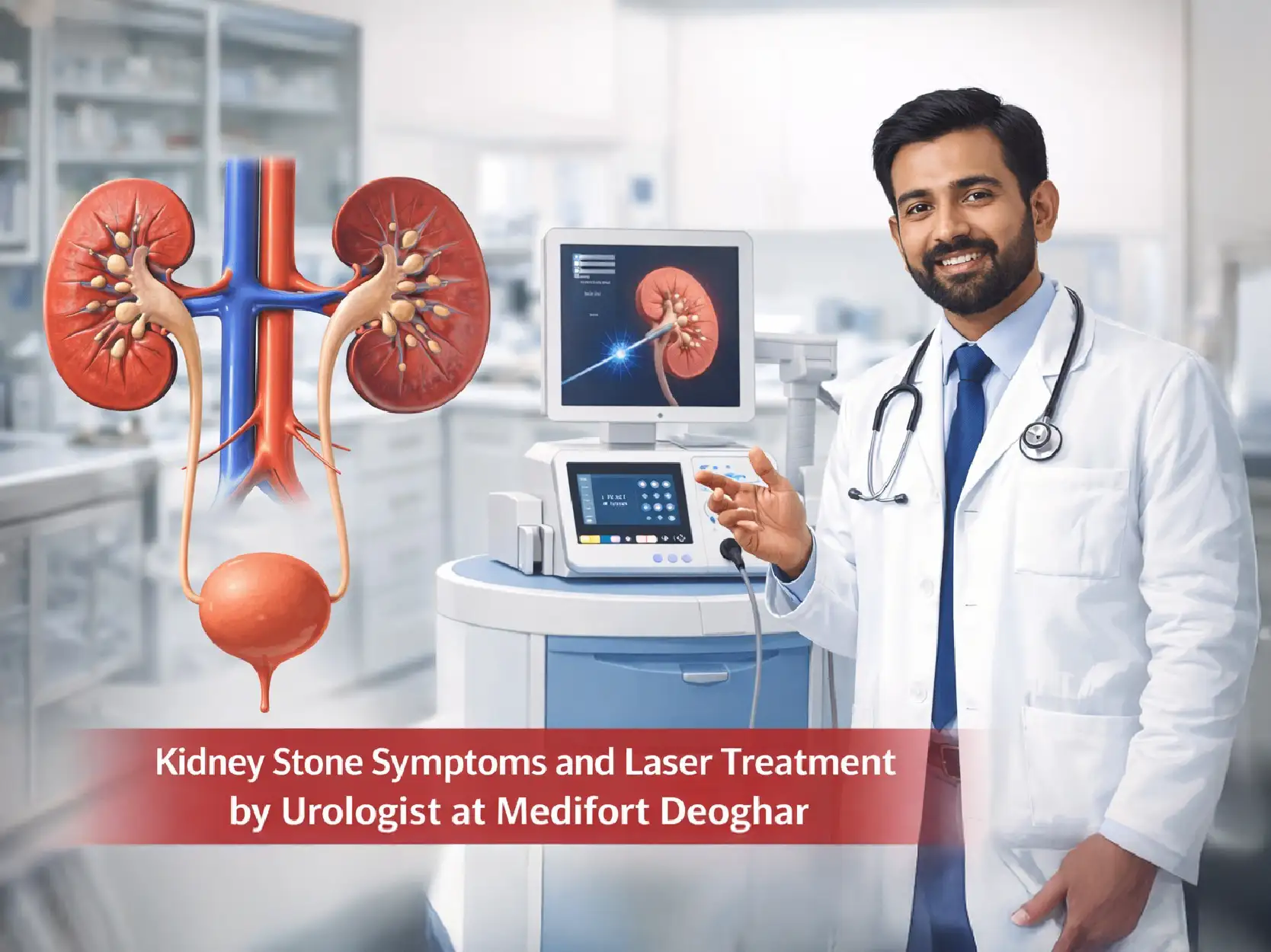
Few medical conditions announce themselves as dramatically as a kidney stone. The sudden, intense pain that radiates from the back into the lower abdomen and groin has been described by patients as among the most severe they have ever experienced. Yet despite how common kidney stones are — affecting roughly one in ten people at some point in their lives — many patients in Deoghar and across Jharkhand delay seeking care, either hoping the pain will pass or unaware that modern treatment options have made stone management far less intimidating than it once was. Speaking with a qualified urologist in Deoghar at the earliest sign of symptoms is the most effective way to protect your kidney health and avoid complications.
This guide covers everything you need to know — from understanding why stones form, to recognising the symptoms, to understanding how minimally invasive treatment options like laser stone removal work.
Understanding Kidney Stones: What They Are and Why They Form
Kidney stones are hard deposits of minerals and salts that form inside the kidneys when urine becomes too concentrated. Under normal circumstances, the substances that make up kidney stones — such as calcium, oxalate, uric acid, and phosphate — are dissolved in urine and expelled from the body. When the urine contains more of these substances than it can dilute, they begin to crystallise and gradually accumulate into stones.
Stones vary widely in size. Some are as small as a grain of sand and pass through the urinary tract without causing significant symptoms. Others grow to several millimetres or even centimetres in diameter and become lodged in the kidney, ureter, bladder, or urethra — causing obstruction, pain, and infection risk.
There are several types of kidney stones based on their composition:
Calcium oxalate stones are the most common, forming when calcium combines with oxalate in the urine. Uric acid stones develop when urine is persistently acidic, often in patients with gout or high protein diets. Struvite stones are associated with urinary tract infections and can grow rapidly. Cystine stones are rare and linked to a hereditary condition affecting amino acid excretion.
Awareness of kidney stones matters because untreated stones can lead to serious complications including urinary tract obstruction, recurrent infections, and long-term kidney damage. In Jharkhand, where heat, dehydration, and dietary habits create favourable conditions for stone formation, the incidence is notably high.
Common Causes and Risk Factors for Kidney Stones
Kidney stones rarely have a single cause. They typically result from a combination of metabolic, dietary, environmental, and lifestyle factors:
- Insufficient fluid intake — Low water consumption is the single most significant risk factor for kidney stone formation. Concentrated urine provides the environment in which minerals crystallise. This risk is amplified in hot climates and among people who work outdoors.
- Diet high in sodium and animal protein — Excess sodium increases calcium excretion through the urine. High consumption of red meat and poultry raises uric acid levels, promoting uric acid stone formation.
- High oxalate diet — Foods such as spinach, tomatoes, nuts, chocolate, and tea are rich in oxalate. When combined with low fluid intake, they significantly increase calcium oxalate stone risk.
- Obesity — Obesity alters urinary chemistry in ways that favour stone formation, including increased calcium and uric acid excretion.
- Family history — A genetic predisposition to abnormal calcium or uric acid metabolism increases stone risk substantially across generations.
- Recurrent urinary tract infections — Chronic or repeated UTIs, particularly with certain bacteria, create conditions favourable for struvite stone development.
- Certain medical conditions — Hyperparathyroidism, gout, inflammatory bowel disease, and some metabolic disorders increase the risk of specific types of kidney stones.
Symptoms You Should Not Ignore
Kidney stone symptoms range from almost imperceptible to severely debilitating depending on the size, location, and movement of the stone. Being aware of what the early symptoms of a kidney stone feel like can help patients in Deoghar seek timely evaluation before the situation becomes an emergency.
Pain is the hallmark symptom and can be one of the most intense a person experiences. It typically begins suddenly in the back or side, just below the ribs, and may radiate downward toward the lower abdomen, groin, or inner thigh as the stone moves through the ureter. The pain often comes in waves, fluctuating in intensity, and does not ease with changes in position — unlike muscular back pain.
Other common symptoms include:
- Blood in the urine (haematuria) — urine may appear pink, red, or brown
- Frequent urge to urinate, or pain and burning during urination
- Nausea and vomiting, often accompanying severe pain episodes
- Cloudy or foul-smelling urine, which may indicate an associated infection
- Fever and chills — these are warning signs of infection and require immediate medical attention
- Difficulty passing urine or reduced urine output, which may indicate obstruction
For patients researching what are the early symptoms of a kidney stone and when to see a urologist in Deoghar — the answer is: as soon as pain, blood in the urine, or urinary symptoms appear. Early evaluation prevents small manageable stones from becoming complicated, infected, or obstructive.
Diagnosis and Medical Evaluation
When a patient presents with suspected kidney stone symptoms, a urologist will conduct a systematic evaluation to confirm the diagnosis, determine the stone’s size and location, and assess kidney function.
Clinical Assessment — A detailed history of symptom onset, location and radiation of pain, urinary changes, prior stone episodes, dietary habits, and family history provides important diagnostic context.
Urine Analysis — A basic urine test can detect blood, crystals, signs of infection, and abnormal mineral concentrations — all of which support the diagnosis of kidney stones.
Blood Tests — Serum calcium, uric acid, creatinine, and electrolytes help assess metabolic factors contributing to stone formation and evaluate kidney function.
Imaging Investigations:
- Ultrasound — A non-invasive, radiation-free first-line imaging test that can identify stones in the kidney and urinary obstruction. It is particularly useful for initial assessment.
- CT Scan (Non-contrast) — The most accurate imaging test for kidney stones. It can detect stones of virtually any composition, measure their size precisely, and identify their exact location in the urinary tract.
- X-ray (KUB) — Useful for monitoring calcium-containing stones and assessing treatment response.
Stone Analysis — When a stone is passed or retrieved, laboratory analysis of its composition guides dietary and preventive recommendations to reduce recurrence.
Treatment Options for Kidney Stones
The appropriate treatment for a kidney stone depends on its size, composition, location, and whether it is causing obstruction or infection. A urologist will recommend the most suitable approach based on individual assessment.
Conservative Management (for small stones) — Stones smaller than 5mm often pass spontaneously with adequate hydration. Patients are advised to drink large volumes of water, use pain relief medications as needed, and use alpha-blocker medications that relax the ureter and facilitate stone passage. Regular monitoring is essential during this period.
Extracorporeal Shock Wave Lithotripsy (ESWL) — This non-invasive procedure uses focused sound waves directed from outside the body to break stones into smaller fragments that can then pass naturally through the urinary tract. It is suitable for certain stone sizes and locations.
Laser Kidney Stone Removal (Ureteroscopy with Laser Lithotripsy) — This is one of the most commonly performed and effective minimally invasive procedures for kidney stones. A thin flexible instrument called a ureteroscope is passed through the natural urinary passage — no incisions are required. The stone is then fragmented using a laser (holmium laser lithotripsy) and the pieces are removed or allowed to pass. Recovery is typically rapid, with most patients discharged the same day or within 24 hours.
Percutaneous Nephrolithotomy (PCNL) — For very large or complex stones, a small incision in the back allows a nephroscope to be passed directly into the kidney to break and remove the stone. This is performed under general anaesthesia and is reserved for cases not suitable for laser ureteroscopy.
Medical Treatment for Recurrence Prevention — Depending on stone composition, medications may be prescribed to reduce recurrence. These include thiazide diuretics for calcium stones, allopurinol for uric acid stones, and potassium citrate to alkalinise urine.
Prevention Tips to Reduce Kidney Stone Risk
The good news is that kidney stones are highly preventable with the right habits. These evidence-based steps are recommended by urologists for patients with a history of stones and for those at risk:
- Drink more water — Aim for at least 2.5 to 3 litres of fluid daily, more in hot weather or with physical activity. The goal is to produce pale, dilute urine throughout the day.
- Reduce sodium intake — Cut down on processed foods, pickles, papadums, and table salt. High sodium diets increase calcium in the urine.
- Moderate animal protein consumption — Limit red meat, poultry, and fish to reasonable portions. Excess protein raises uric acid and calcium excretion.
- Eat calcium appropriately — Contrary to common belief, dietary calcium from food sources is not harmful and may actually help bind oxalate in the gut, reducing its absorption. Avoid excessively high calcium supplements without medical guidance.
- Limit high-oxalate foods if relevant — If your stones are calcium oxalate type, moderate intake of spinach, nuts, beets, and strong tea, particularly in the absence of adequate hydration.
- Maintain a healthy weight — Obesity-related metabolic changes increase stone risk. Even modest weight reduction helps normalise urinary chemistry.
- Follow up after a stone episode — A metabolic evaluation after passing a stone helps identify specific dietary and medication strategies to prevent recurrence.
When Should You See a Urologist?
Not every stone requires emergency treatment, but certain situations demand prompt specialist evaluation. Consider consulting a urologist without delay if:
- You are experiencing severe, sudden pain in the back, side, or lower abdomen
- You notice blood in your urine, even without pain
- You develop fever or chills alongside urinary symptoms — this combination may indicate a kidney infection and should be treated as an emergency
- You have a known stone that is not passing after several days despite adequate hydration
- You have a single functioning kidney and develop stone symptoms
- You have experienced recurrent kidney stones and wish to understand how to prevent further episodes
For patients searching for the best laser kidney stone removal surgery hospital in Deoghar, Jharkhand — the key criteria are the availability of urological expertise, advanced endoscopic equipment, and a team experienced in managing both routine and complex stone cases.
How Medifort Wellness Super Speciality Hospital in Deoghar Can Help
Medifort Wellness Super Speciality Hospital provides comprehensive urological care for patients across Deoghar, Dumka, Jasidih, Godda, and the wider Jharkhand region. The hospital’s urology department is equipped to manage the full spectrum of kidney stone conditions — from initial diagnosis and conservative management through to advanced minimally invasive procedures.
For patients seeking to understand how Medifort Hospital Deoghar’s urology department treats kidney stones without open surgery, the answer lies in the availability of ureteroscopy with laser lithotripsy — a procedure that requires no external incisions, offers high stone clearance rates, and allows most patients to return to normal activity within a few days. The hospital’s endoscopic and laser equipment supports safe and effective stone management across a range of stone sizes and locations.
Diagnostic capabilities including ultrasound, CT imaging, and comprehensive urine and blood investigations enable accurate assessment before any intervention is planned. Post-procedure care and metabolic evaluation for recurrence prevention are integrated into the follow-up process.
The team at Medifort understands that a kidney stone episode is distressing and often occurs without warning. Providing clear communication — about what investigations are needed, what treatment involves, and what to expect during recovery — is a fundamental part of how the hospital supports its patients through the process.
Frequently Asked Questions
Q1. What are the early symptoms of a kidney stone and when should I see a urologist in Deoghar? Early symptoms include dull or intermittent aching in the back or side, slight discolouration of urine, and increased urinary frequency. You should see a urologist as soon as these symptoms appear, particularly if they are accompanied by blood in the urine or worsen over time. Early evaluation prevents small stones from becoming complicated.
Q2. Is laser kidney stone removal safe and painful? Laser ureteroscopy (ureteroscopy with holmium laser lithotripsy) is a well-established, minimally invasive procedure performed under anaesthesia. Patients do not feel pain during the procedure. Post-procedure discomfort is usually mild and manageable with medication. The absence of external incisions means a significantly faster recovery compared to open surgery.
Q3. Can kidney stones come back after treatment? Yes. Without appropriate preventive measures, recurrence rates are relatively high — approximately 50% within ten years of the first episode. A metabolic evaluation after stone treatment, combined with dietary adjustments and, where needed, medication, substantially reduces recurrence risk.
Q4. How much water should I drink to prevent kidney stones? Most urologists recommend a fluid intake sufficient to produce at least 2 to 2.5 litres of urine per day. For most adults, this means drinking 2.5 to 3 litres of water or other fluids daily, with higher intake in hot weather or during physical activity.
Q5. Is every kidney stone treated with surgery? No. Small stones, typically under 5mm, are often managed conservatively with hydration, pain relief, and medication to assist passage. Treatment decisions depend on stone size, location, symptoms, and kidney function. A urologist in Deoghar will recommend the most appropriate approach after a thorough evaluation.
Q6. Does Medifort Wellness Hospital in Deoghar offer kidney stone treatment without open surgery? Yes. Medifort Wellness Super Speciality Hospital offers laser ureteroscopy and other minimally invasive urological procedures for kidney stone management, avoiding the need for open surgical incisions in most eligible patients.
Conclusion
Kidney stones are common, painful, and — with the right care — very manageable. Modern urology has transformed what was once a condition requiring open surgery into one that is typically treated through a brief, minimally invasive procedure with a rapid return to normal life. The key is not to delay.
Whether you are experiencing your first episode of flank pain, dealing with a recurrent stone problem, or simply trying to understand how to reduce your risk, the right starting point is an honest conversation with a qualified urologist. For patients in Deoghar and the surrounding districts of Jharkhand, that conversation is closer than you may think.
If you are experiencing symptoms of a kidney stone or have questions about your urological health, reach out to the urology team at Medifort Wellness Super Speciality Hospital, Deoghar. Early evaluation is always the right first step toward lasting relief.
This article is intended for general health awareness and educational purposes only. It does not substitute professional medical advice, diagnosis, or treatment. Always consult a qualified healthcare professional for personal medical concerns.